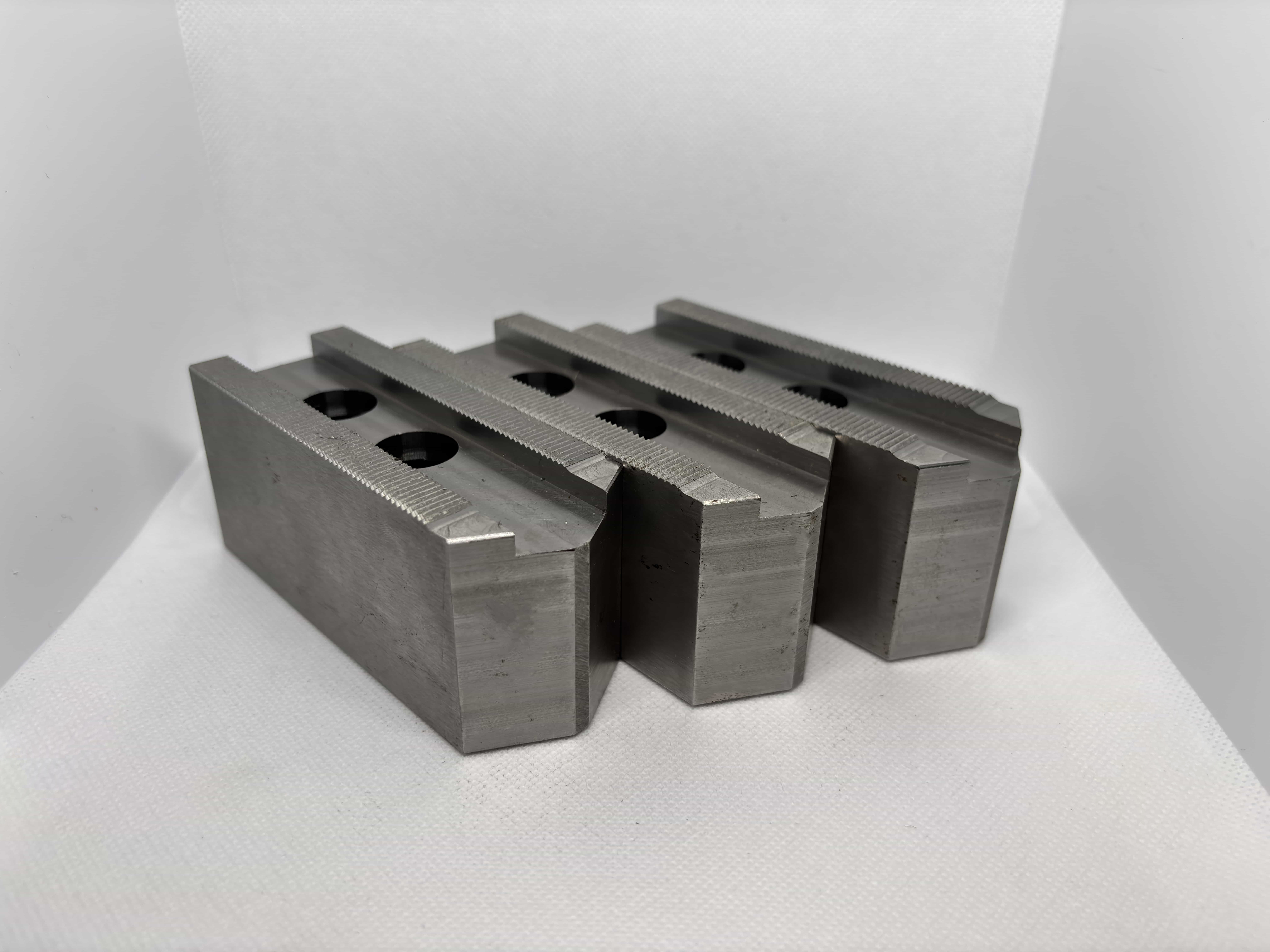
Ordering chuck jaws “like the old ones” can look straightforward — until the new set doesn’t seat properly, bolt holes don’t match, the stroke range is wrong, grip length is insufficient, or repeatability deteriorates.
To make sure a new set fits your chuck without rework and performs predictably in real cutting conditions, you need a clear technical brief. The good news is that in most cases you don’t need a complex package — a structured checklist plus a few photos are enough.
Below is a practical list of information that helps manufacture lathe chuck jaws efficiently and avoid the most common mistakes.
Why “make it like this photo” often fails
Even chucks that look similar can have different jaw interfaces:
- guide/serration type and profile (fit, pitch, geometry);
- bolt pattern and fastener sizes;
- locating faces and seating planes;
- stroke limitations (what diameter range is actually clamped);
- monoblock jaws vs. master jaw + top jaw systems.
That’s why a jaw can be “close” yet still not fit, or fit but fail to deliver accuracy and repeatability.
Step 1 — Define what jaw type you need
Start by defining the application. This determines jaw geometry, material, and finishing requirements.
- Straight jaws — external clamping on the OD (shafts, bar work, cylindrical blanks).
- Reverse jaws — internal clamping on the ID (sleeves, rings, parts with a bore).
- Combination jaws — for quick OD/ID switching within a certain range.
- Soft jaws or replaceable top jaws — for serial production, thin-walled parts, delicate surfaces, and high repeatability.
If you are unsure, describe the operation: part type, clamping datum (OD/ID), cutting conditions, and required accuracy. The right jaw type usually becomes obvious.
Step 2 — Chuck data (mandatory)
Provide the key information about the chuck:
- chuck type: manual or power (hydraulic/pneumatic), self-centering or independent;
- number of jaws: 3-jaw or 4-jaw;
- model / marking (photo of the nameplate is ideal);
- jaw system: monoblock jaws or master jaw + top jaw;
- clamping direction: external and/or internal;
- space constraints: limits in height/width due to stops, chuck body, guarding, turret clearance, etc.
The clearer the chuck description, the lower the risk of an interface mismatch.
Step 3 — Jaw mounting interface (the #1 cause of “it doesn’t fit”)
This section describes how the jaw seats on the chuck.
If possible (drawing, measurement, or sample), specify:
- interface type (guideways, serration/rack, tongue-and-groove, etc.);
- serration pitch/profile or guideway dimensions;
- locating faces (where the jaw must seat without gaps);
- fastening: number of bolts, center distances, diameters, depths, thread types;
- jaw numbering / order (if maintaining 1-2-3 / 1-2-3-4 matters).
If you have an old set, the most reliable approach is to provide a jaw sample (or master jaw/top jaw) so all interface dimensions can be captured accurately.
Step 4 — Workpiece and clamping data
To ensure the jaws actually hold the part (not just “close”), provide clamping parameters:
- clamping diameter(s) (working range, min/max);
- grip length (how many millimeters of contact);
- workpiece material and surface condition (rough/finished, risk of marking);
- stick-out length and whether loads are interrupted (impact, chatter);
- what matters more: maximum holding force or surface protection (no marks);
- tool access needs (facing, grooving, threading, turning near shoulders/flanges).
Helpful attachments:
- part drawing or a simple sketch with the clamping zone highlighted;
- photo of the part mounted in the chuck (current setup) and the desired setup.
Step 5 — Accuracy and repeatability requirements
Define a realistic target for your process.
Specify:
- allowed runout (where it is measured: diameter, length, and condition);
- whether you need repeatability after re-clamping without indicating;
- contact surface requirements (smooth / serrated / inserts);
- maximum RPM (if relevant) and balancing expectations;
- whether grinding/lapping of seating or working faces is required (often critical for serial work).
If runout is inconsistent, the cause can be the chuck condition as well as the jaws. In those cases, checking wear and cleanliness of seating surfaces is important.
Step 6 — Material, hardening, service life
If you know the service-life target, include it. If not, describe operating conditions — that is often enough to select the right steel and heat-treatment route.
- cutting conditions: light finishing vs heavy roughing, interrupted cuts;
- what happens to current jaws: wear, serrations rounding off, chipping, cracking;
- what is the priority: wear resistance, impact toughness, minimal distortion, accuracy.
Based on this, the manufacturer can recommend a suitable route (through-hardening, case hardening, nitriding, etc.) to achieve wear resistance without cracking and with controlled geometry.
No drawings? How to collect data quickly
In real production, complete drawings are often unavailable — that’s normal.
Practical options:
- send an existing jaw as a sample (fastest and most reliable);
- take photos of the interface with a ruler/caliper in the frame;
- mark photos: “locating face”, “stop”, “hole #1”, etc.;
- if there are multiple jaws, label them (1-2-3) and show the installation order.
Better input data means faster manufacturing and fewer revisions.
Common specification mistakes (and how to avoid them)
- providing only “chuck diameter” but not the model and jaw interface;
- confusing master jaws with top jaws (different interfaces);
- missing clamping range and grip length;
- ignoring space constraints and tool clearance;
- requesting “maximum hardness” without considering impact loads (often leads to chipping);
- not stating whether surface marks are acceptable.
How Promservice approaches custom jaws
To deliver predictable results, the process typically includes:
- reviewing the application and available chuck/part data;
- selecting jaw type and working-surface geometry;
- choosing material and hardening for your cutting conditions;
- machining and, if needed, heat treatment;
- finishing (grinding/lapping) of critical seating surfaces;
- inspection of geometry and fit to agreed criteria.
Need custom chuck jaws?
To start quickly, send:
- chuck model/nameplate photo;
- 2–3 photos of the jaw mounting interface;
- part drawing (or sketch) with clamping diameter(s);
- runout/repeatability requirements (if any);
- brief description of cutting conditions and current jaw issues.
Promservice manufactures lathe chuck jaws and other workholding tooling for machine tools — tailored to your part, your process, and your accuracy targets.