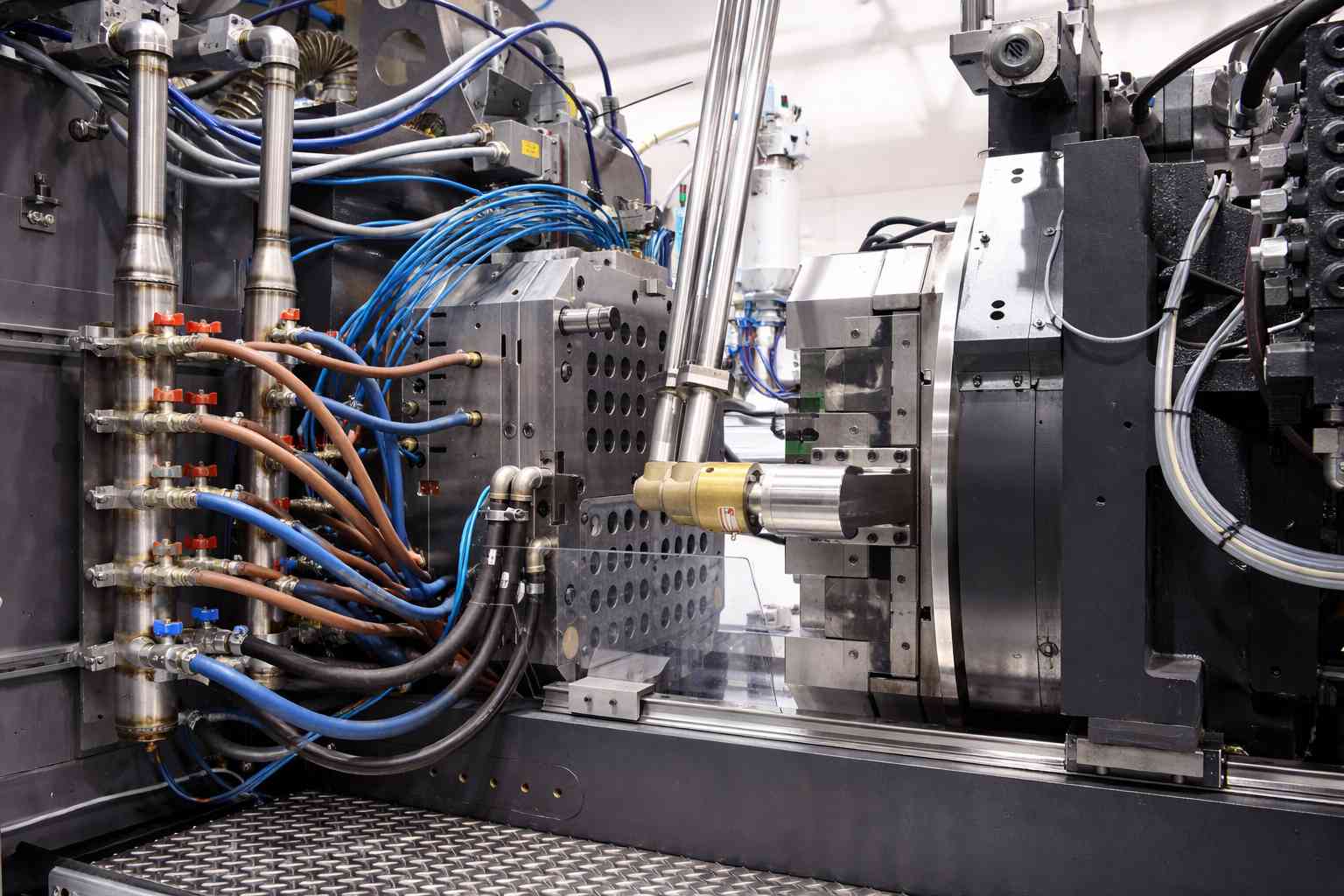
In injection molding, the cost of a part is determined not only by the polymer price and the number of cavities. In serial production, two things often decide everything:
- cycle time (how many parts you can produce per shift);
- warpage (whether parts keep their geometry and fit during assembly).
Both parameters are strongly influenced by the same factor — mold cooling. An optimized cooling system helps shorten the cycle, stabilize dimensions, reduce scrap, and extend tooling life. Promservice designs and manufactures injection molds in Ukraine and pays special attention to cooling during engineering, trial runs, and further mold service.
Why cooling is “where the money is”
A typical injection molding cycle includes filling, packing/holding, cooling, and ejection. In many cases, cooling is the longest stage. If the cooling time is too long, you lose productivity. If cooling is uneven, you lose dimensional stability — and warpage appears.
That is why cooling is not just “drilled holes with water.” It is an engineering system that must deliver:
- the correct temperature range for the polymer;
- stable flow and heat removal in every zone of the part;
- repeatability from cycle to cycle and from cavity to cavity.
What is a mold cooling system?
The cooling system is a set of channels, fittings, and circuits that carry a coolant (usually water or a water-based fluid) through the mold plates and inserts. Its goal is to remove heat from the plastic and keep the tool at a controlled, stable temperature.
In well-designed molds, cooling is built around:
- the geometry of the part (wall thickness, ribs, bosses, hot spots);
- cavity/core heat balance (both halves must be controlled);
- separate circuits for different zones when needed;
- stable flow (no air locks, no “dead zones”, consistent pressure).
How cooling reduces cycle time
Cycle time cannot be reduced “by force.” If you simply open the mold earlier, the part may deform, stick, or shrink unpredictably. The correct approach is to improve heat removal so the part reaches a stable ejection condition faster.
Cooling influences cycle time through:
- temperature difference between polymer and mold surface;
- contact area and how uniformly the surface is cooled;
- flow rate and turbulence inside cooling channels;
- hot spots that force you to keep the part longer “just to cool that one area.”
In practice, a good cooling layout can reduce cycle time without changing part design — just by making cooling more uniform and efficient.
Why warpage happens: temperature imbalance = uneven shrinkage
Warpage is usually not “bad plastic.” Most often it is the result of uneven cooling and therefore uneven shrinkage. Typical scenarios:
- thick sections cool slower than thin walls and “pull” the part;
- one side of the part cools faster than the other (core vs cavity imbalance);
- areas near ribs, bosses, or inserts create local hot spots;
- cavities in multi-cavity molds are cooled differently, causing variation.
The part leaves the mold with internal stresses. Later, it can bend during storage, packaging, or assembly — even if it looked “ok” right after ejection.
Typical cooling problems in operating molds
Even a well-designed mold can lose cooling efficiency over time. The most common issues are:
- clogged channels (scale, corrosion, deposits);
- reduced flow due to incorrect hose connections or fittings;
- long circuits with high pressure loss (weak flow at the end);
- missing or ineffective cooling near hot zones;
- air locks and “dead ends” where water does not circulate;
- coolant temperature instability because of inadequate thermoregulation.
If a mold suddenly requires a longer cycle or starts producing warped parts, cooling is one of the first systems to check.
Engineering solutions: what can be done in mold design
At the mold design stage, the cooling concept is developed together with gating, venting, and ejection. Promservice engineers focus on several proven principles:
- Correct channel placement relative to the cavity surface (to remove heat where it is generated).
- Separate circuits for zones with different heat loads (for example, thick sections or areas near inserts).
- Balancing core and cavity cooling to minimize side-to-side temperature gradients.
- Using special cooling elements where drilling is not enough:
- baffles for directional flow in narrow areas;
- bubblers for deep cores and localized cooling;
- compact circuits inside inserts for critical hot spots.
- Designing circuits for stable flow (avoiding dead ends, optimizing lengths, using proper fittings).
- Planning maintainability: access for cleaning, replaceable inserts in wear zones, and safe sealing of plugs.
If required, cooling efficiency can be evaluated using engineering calculations and simulation to avoid “trial-and-error” in production.
Process settings matter too (but they do not replace cooling)
Cooling problems are sometimes “hidden” by machine settings, but this usually creates new issues. Correct cooling should be supported by correct processing parameters:
- mold temperature set to the material requirement;
- stable holding time and pressure to control shrinkage;
- reasonable cooling time based on real part temperature at ejection;
- stable water flow and monitored inlet/outlet temperatures.
Promservice helps tune the process during trial runs so the mold works efficiently without sacrificing stability.
Maintenance: cleaning cooling channels is not optional
To keep cycle time and warpage under control in long production runs, the cooling system must be maintained. A practical maintenance program includes:
- periodic flushing and cleaning of cooling circuits;
- inspection of plugs, seals, and fittings for leakage;
- monitoring flow rate and temperature difference (in/out);
- using filters and controlling water quality to reduce scale;
- documenting optimal operating parameters for each mold.
Regular cleaning of cooling channels is one of the most cost-effective actions — it prevents productivity loss and protects the mold from corrosion and overheating.
Modernization of existing molds: how to fix cooling without making a new tool
If you already have a mold and want to improve cycle time or reduce warpage, modernization can often solve the problem faster than building a new tool. Typical upgrade options include:
- adding new drilled channels where geometry allows, with sealed plugs;
- installing baffles or bubblers in problematic zones;
- dividing one long circuit into two shorter ones for better flow balance;
- upgrading fittings and quick couplings to reduce pressure loss;
- redesigning individual inserts with improved cooling (local “hot spot” solution);
- restoring damaged or corroded channels during refurbishment.
Promservice performs mold repair and modernization, including cooling system diagnostics and improvements to return the tool to stable production.
Need cooling optimization for your injection mold in Ukraine?
Promservice designs and manufactures injection molds with optimized mold cooling systems, and provides maintenance, repair, and modernization for operating tooling. Contact us — we will analyze your part and mold, identify cycle time and warpage drivers, and propose an engineering solution with clear production benefits.