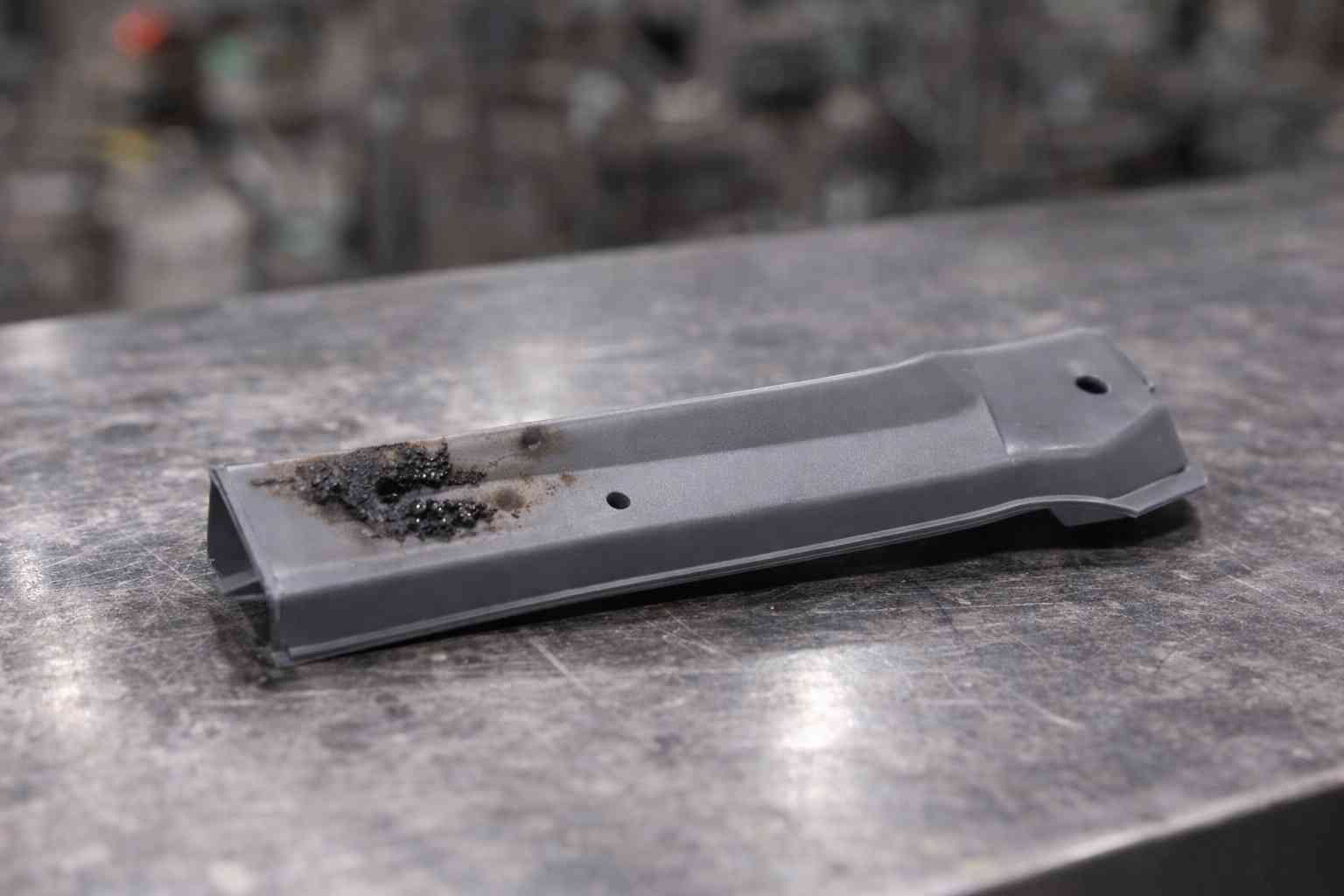
In injection molding, the cavity is filled in fractions of a second — but before molten polymer can occupy that space, air and gases must leave it. If they can’t, the result is usually the same: burn marks (dieseling), short shots (underfilling), unstable dimensions, and higher scrap.
This is why mold venting is not a “small detail.” It is a key engineering element that determines both part quality and process stability. Promservice designs and manufactures injection molds in Ukraine and helps customers eliminate venting-related defects through correct mold engineering, trial tuning, and modernization of operating tooling.
What are burn marks and why do they happen?
Burn marks (often dark brown/black streaks) typically appear near the end of fill — where the melt front reaches the last zones of the cavity and compresses trapped air. When the polymer compresses the air faster than it can escape, the air heats up sharply. This effect is commonly called dieseling.
Typical symptoms that point to venting issues:
- burn marks at the same locations cycle after cycle;
- short shots or incomplete filling in the same zones;
- need to increase injection pressure to “force” the fill;
- part weight variation and poor repeatability;
- flash at the parting line after “turning up” pressure to compensate.
What is a gas trap?
A gas trap is a zone where air is “locked” by the way the plastic flows through the cavity. Even if the mold has vents, flow patterns can cause air to be trapped in pockets that are not connected to those vents.
Gas traps are common in parts with:
- ribs and bosses (air pocket behind obstacles);
- deep pockets and blind features;
- long flow paths with narrowing sections;
- multiple flow fronts that meet and close off escape routes;
- insert-molded components (air around inserts).
Understanding gas traps is important because you can have “vents everywhere on the parting line” and still get burn marks — simply because the trapped air has nowhere to go at the moment of filling.
Where venting is required most
In a well-designed injection mold, vents are placed where they actually work — not just where it’s convenient.
Most important venting zones:
- End-of-fill areas (the last places the polymer reaches).
- Around ribs and bosses, especially behind tall ribs or near thick junctions.
- Weld-line zones where flow fronts meet (air gets trapped and weakens the part).
- Deep cavities and cores, where air pockets form easily.
- Textured surfaces, which can seal earlier and reduce natural micro-venting.
- Ejection system and moving elements (air often escapes through ejector pins and sliders when designed correctly).
Common venting solutions used in molds
There is no single “best vent.” Good venting is a combination of design and execution. Typical solutions include:
Parting line vents Small vent grooves in the parting line are the most common method. The vent depth is usually very small and depends on the material and part requirements — enough to release air, but not enough to flash.
Ejector pin venting Proper clearance and engineered vent paths around ejector pins can remove gases from local zones, especially in deep cavities.
Venting through inserts and split lines In complex molds, venting is often implemented through insert interfaces or additional split lines in critical areas.
Porous vent inserts / vent plugs Special venting elements can be used in hard-to-vent zones to let gas escape without allowing polymer to flow out (application depends on material and part).
Overflow pockets (where applicable) For some geometries, controlled overflow zones can help trap contaminated melt/air and improve surface quality.
Promservice engineers select venting solutions based on part geometry, polymer type, expected production volume, and customer requirements for appearance and tolerances.
Process parameters: help, but do not replace proper venting
It is possible to reduce burn marks by changing machine parameters — but this often hides the problem instead of solving it. Typical process actions (used carefully and only as part of a complete solution):
- adjust injection speed profile (often slower in the last part of fill);
- reduce melt temperature (if material allows);
- optimize holding pressure and time to avoid overpacking;
- ensure proper clamp force (to avoid unintended flashing).
If the mold physically cannot release trapped gases, the process window will remain narrow. Stable serial production requires engineering-level venting.
How to diagnose venting problems in a running mold
When customers come with recurring burn marks or short shots, practical diagnostics usually includes:
- identifying the defect location and correlating it with end-of-fill zones;
- checking whether the vent grooves are contaminated (oil, resin, deposits);
- measuring part weight variation and injection pressure trends;
- evaluating whether the parting line is worn or the mold is misaligned;
- checking if cooling imbalance is causing early freeze-off (looks like short shot);
- confirming that flow patterns do not create “closed” gas pockets.
Often, what looks like “not enough venting” is a combination of vent design, wear, and process settings.
Maintenance: vents must stay clean and sharp
Even perfectly designed vents will stop working if they are not maintained. In production, venting can be blocked by:
- resin build-up and degraded polymer deposits;
- rust and corrosion;
- release-agent contamination;
- parting line wear (vents become ineffective or create flash).
A simple maintenance routine helps keep the process stable:
- regular cleaning of vent grooves and critical split lines;
- visual inspection of end-of-fill zones;
- documenting optimal process parameters for each mold;
- scheduled checks after a defined number of cycles.
Mold modernization: fixing gas traps without building a new mold
If the mold is already in operation, venting can often be improved through targeted modernization. Typical upgrades include:
- adding vent grooves at end-of-fill areas and behind ribs/bosses;
- creating local venting through inserts or split lines in problematic zones;
- implementing vented ejector pins in deep pockets;
- correcting alignment issues and restoring worn parting surfaces;
- refining gating or runner layout to change flow patterns and remove gas traps;
- polishing/finishing critical surfaces to reduce early sealing and burn risk.
Promservice performs mold repair and modernization, including venting improvements, to expand the stable process window and reduce defects.
Need help eliminating burn marks or short shots?
Promservice supports customers with injection mold design, manufacturing, trial runs, and service across Ukraine. If you face burn marks, gas traps, or underfilling, contact us — we will analyze the part and tooling, propose an engineering fix, and help you achieve stable serial production with predictable quality.